
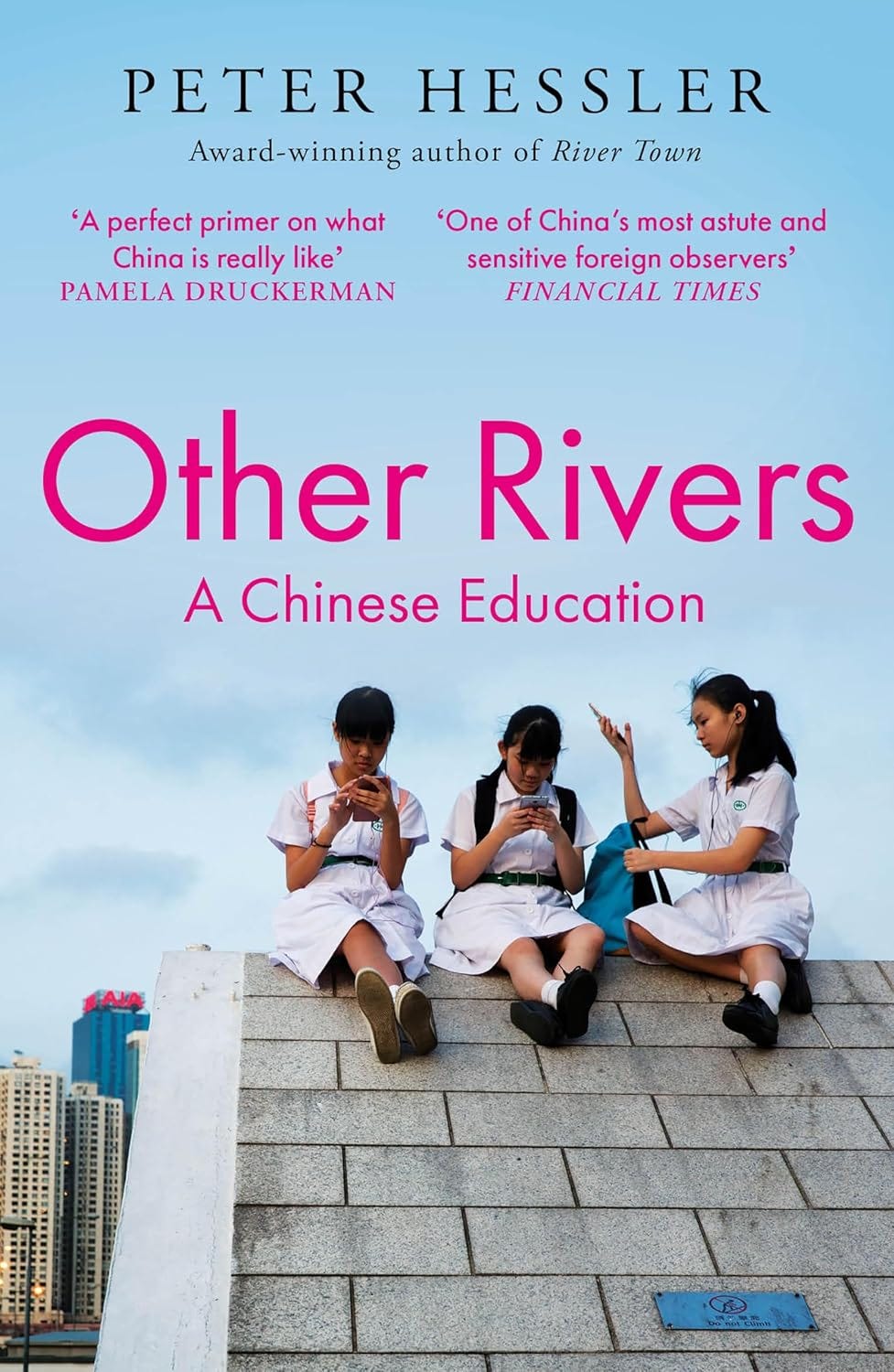
Book Review – Other Rivers – Peter Hessler
Peter Hessler made his name with a book called River Town, about a small, third tier city in Sichuan called Fuling where he was posted by the US Peace Corps as an English writing teacher in the late 1990s.
That book became deservedly well-known for its sensitive and textured depiction of place and people : a town undergoing rapid change and a generation of students experiencing some of the freedoms, and restrictions, of university life, as China accelerated through the fastest economic and cultural developmental journey in human history.
Hessler has a calm and understated observational style. His prose flows like the Yangtze river through Fuling – soothingly steady, swelling at times, and most interesting in the little eddies and digressions it explores.
Over 20 years later, in 2019, Hessler and his Chinese wife Leslie and twin daughters Natasha and Ariel, returned to Sichuan – this time to Chengdu and Sichuan University - to teach journalism and non-fiction writing.
As with River Town the book explores the changing cultural, political and economic landscape of China through excerpts from the essays of his students. Hessler sets them writing assignments and receives writing proposals from them. Their suggestions are sometimes surprising and bold : research into a gay bathroom in the city ; an investigation of bar culture ; an expose of irresponsible doctors ; how religion works in China. It is these authentic voices – snapshots of local journalism - that mark out both of Hessler’s books from the more traditional personal first-person memoirs or travelogues.
But, in “Other Rivers” he has the support of an additional viewpoint : from his twin girls as they navigate the Chinese public school system for the first time. And, perhaps most interestingly, his two-year stint starts just before and ends just after one of the most tumultuous social events both in China and the world : the outbreak, management and aftermath of the COVID-19 pandemic.
Hessler’s skill lies in painting the big picture of the pandemic - its outbreak, the severity of the government response and the numbing bureaucracy of the authorities - by picking out small details and framing personal stories that serve as emblems of the larger frame.
He recounts, for example, how the neighbourhood committee needed to record every foreigner in every compound : check their temperature ; contacts with others ; places visited, etc. Two men arrived, dutifully asked questions and when finished asked to take a photo with Hessler. Then, Hessler writes :
“After taking the picture, the man removed his jacket and asked if I would pose again in slightly different part of the living room.
“Do you know why I’m doing this? He asked with a grin.
Leslie said “Because you’re supposed to come here twice ?” “Right on!” I asked if he wanted me to change my shirt…and for good measure, I also loaned him a jacket.”
After interviewing almost all his contacts, and making a visit to Wuhan himself, Hessler concludes that the government response to COVID amplified many of the strengths and weaknesses of Chinese bureaucracy. From the initial attempted cover-up, to a second phase of a coherent and effective national strategy that reduced the severity of the impact, to a final, chaotic, phase where indecision and rigidity dictated by just one man kept restrictions for far too long.
The Hesslers’ daughters started school as the only Americans in the third grade of the Chengdu Experimental Primary School. His dry humour suffuses his descriptions of Chinese “helicopter parenting” (terrifying), the complex maths problems standard in the curriculum, the comical attitudes to risk and the pressures felt by parents and student alike to constantly compete.
For example, in Morality and Rules class a story of a little boy who plays with his father’s cigarette lighter in a field ends :
“But, he suffered extensive burns all over his body, resulting in permanent disability. Blind curiosity and careless experimentation have brought great misfortune to Mo Mo, his family and society”.
Hessler is equally good at showing how children adapt, how high standards expected become high standards met and how parents are expected to be co-authors in their children’s development. His daughters end school having become fluent in Chinese, popular with classmates and teachers, but without losing critical and questioning mindsets, rather, becoming masters at sublimating them.
In moving backwards and forward between the 1990s and 2020s Hessler also closely observes the differences between the generations. His former students, the Reform Generation, now working, married, divorced, with and without children see themselves as lucky. Their parents knew incredible hardships – the terrible famine of 1955-57, grinding poverty and the upheavals of the Cultural Revolution. They were the ones who experienced the opening up, the widening of horizons and the optimism created by a roaring economy.
The COVID generation of the 2020s has known some of this, but, has also felt the constricting hand of widespread censorship and surveillance, the trauma of the COVID years and an economy deflating like an old party balloon. When Hessler surveyed his students on their desires to have children 18 out of 24 women who responded said they didn’t. One woman said :
“We are already a confused generation, and children’s upbringing requires long periods of companionship and observation and guidance, which is difficult to ensure in the face of intense social pressure.”
China’s population is falling steadily and large numbers of schools are closing every year – the pressure that is already felt across the education system can only continue to rise.
Throughout this book there is an ever-present thread of love of China and Chinese people. The students, teachers and friends Hessler reveals are complex personalities, humorous, often clear thinking and with a considerably more sophisticated understanding of western countries than their counterparts in American or Europe. They are frequently self-aware, well attuned to self-censorship, and masters of cognitive dissonance.
Hessler’s own relationship with them – the fact that even 20 years later he still corresponds regularly with most of his Fuling cohort, and now with his Chengdu cohort - is testament to his genuine affection for them (warmly reciprocated) and the source of many of the most enlightening stories in this engaging and highly readable book ; a book which allows you a glimpse beyond the curtain of current superficial stereotypes to the messy and contradictory reality of China itself.
Andy Brock, October 2025